
Beolab 8000
(1992-2010) Active column loudspeaker
Description
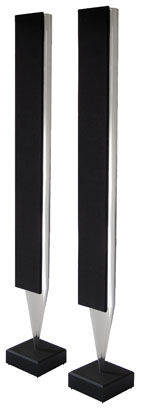
The Beolab 8000 was one of the most successful B&O loudspeakers ever, remaining in the range for many years without change to its external appearance or basic technical specification. It combined elegant styling and good performance in a perfect balance, and despite being expensive, remained a popular choice for both music and video systems. For the latter the Beolab 8000 really excelled – at the time of its launch multi-channel “surround sound” equipment was becoming available in the form of the Beosystem AV 9000, which required four external loudspeakers. The small floor area required by the Beolab 8000 made it ideal, whilst the built-in amplifier helped minimise the size of the rest of the equipment. The Beolab 8000 was also recommended for use with the Beocenter 9500, which was fitted with Powerlink sockets for easy connection. Text copyright © Beocentral. Unauthorised reproduction prohibited.
Technically, the Beolab 8000 continued along similar lines to the pattern set by the Beolab 2500. By using two separate power amplifiers built into the loudspeaker cabinet (one for bass, one for treble), an electronic crossover filter could be used to divide up the sound, allowing for far greater flexibility than was possible with traditional passive designs. Text copyright © Beocentral. Unauthorised reproduction prohibited.
The loudspeaker drivers themselves consisted of two small woofers and a dome tweeter. The cabinet principle was that of bass reflex, with a single port at the top of the column. In the earlier models one of the woofers was connected to the bass amplifier output via a simple passive filter so that it functioned as a midrange driver. This made the early Beolab 8000 a 3-way design with an unusual “hybrid passive-active” construction. Although the use of a heavily damped cone loudspeaker for the midrange rather than an oversize dome unit lacked refinement the results were still quite pleasant. Unfortunately the buying public, educated over the years to believe that “more bass = higher quality” were not completely convinced so later models, those after No. 10145230, dispensed with the expensive crossover components and had both woofers wired in parallel, making the new models only a 2-way design. At the same time the electronic crossover filter was redesigned to include “adaptive bass linearisation”, a system that gave a bass lift at low listening levels. This was of course “loudness” by another name, although the method of applying it involved a complex electronic circuit that was sensitive to signal level rather than the position of the volume control of the main system. Although these changes increased the showroom impact of the Beolab 8000 at the point of purchase they made it a blunter instrument and less satisfying for the serious listener. Text copyright © Beocentral. Unauthorised reproduction prohibited.
Despite the drivers being permanently connected to an amplifier of known characteristics, the designers chose them poorly, during the life of the loudspeaker both had to be modified for satisfactory, reliable operation. Some of the woofers used had a plastic cone which would melt and become detached from the voice coil, whilst the tweeter was insufficiently robust and would fall into permanent silence if the full power of the amplifier was used. The tweeter problem was made worse because there was no blocking capacitor to protect the delicate windings of the tweeter voice coil from the output of the treble amplifier, an elaborate (but largely ineffective) “tweeter protection circuit” was included instead. Text copyright © Beocentral. Unauthorised reproduction prohibited.
Connections could be made by either Powerlink or at line level via an RCA socket. The connections were hidden at the rear behind a slim hinge-out panel. The whole cabinet was styled so that it could be free-standing in the centre of a room without having an “ugly side” at the rear which would have to be hidden. Unlike some of the other Beolab loudspeakers, the Beolab 8000 did not have the option to manually alter the bass level to compensate for its positioning. No stands or brackets were available, the Beolab 8000 was for floor standing use only, and was supplied complete with a lead-filled cast iron base. The amplifier operated automatically when a signal was sensed and had no user controls. An LED indicator mounted behind the cloth showed red for standby, green for operation and orange for a fault, such as overheating. Text copyright © Beocentral. Unauthorised reproduction prohibited.
The timeless styling of the Beolab 8000 meant that as new systems were introduced it matched them perfectly. It became the natural choice for use with the BeoSound 9000. It remained in production for 18 years with the only major change to its appearance being the introduction of a choice of colours for the metal surfaces. Text copyright © Beocentral. Unauthorised reproduction prohibited.
Beolab 8000 was replaced by the visually almost identical BeoLab 8002. Text copyright © Beocentral. Unauthorised reproduction prohibited.
Designer
Type numbers
Finishes/ colours
| 1992 | 1993 | 1994 | 1995 | 1996 | 1997 | 1998 | 1999 | 2000 | 2001 | |
|---|---|---|---|---|---|---|---|---|---|---|
| Aluminium/black | ||||||||||
| Dark grey | ||||||||||
| Blue | ||||||||||
| Red | ||||||||||
| Black | ||||||||||
| Aluminium/white | ||||||||||
| Golden/black1 |
| 2002 | 2003 | 2004 | 2005 | 2006 | 2007 | 2008 | 2009 | 2010 | |
|---|---|---|---|---|---|---|---|---|---|
| Aluminium/black | |||||||||
| Dark grey | |||||||||
| Blue | |||||||||
| Red | |||||||||
| Black | |||||||||
| Aluminium/white | |||||||||
| Golden/black1 |
NOTE 1: special order
Prices
| 1992 | £1,800 |
| 1993 | £2,025 |
| 1994 | £1,900 |
| 1995 | £1,999 |
| 1996 | £2,100 |
| 1997 | £2,100 |
| 1998 | £2,100 |
| 1999 | £2,100 |
| 2000 | £2,150 |
| 2001 | £2,200 |
| 2002 | £2,150 |
| 2003 | £2,150 |
| 2004 | £2,300 |
| 2005 | £2,350 |
| 2006 | £2,350 |
| 2007 | £2,550 |
| 2008 | £2,800 |
| 2009 | £2,995 |
| 2010 | £2,940 |
| 2011 | £3,290 |
Further Reading
In print:
- Jarman, T; Jarman, N (2008), Crowood Collectors' Series: Bang & Olufsen: 162, 163, 170, 174, 194